Beliefs are simply repeated thoughts and emotions that become the unconscious filter through which we see the world. Over time, these repeated patterns shape how we interpret our experiences, how our nervous system responds, and whether our brain perceives life as safe or threatening.
To begin changing beliefs, we first have to bring them into awareness. That requires curiosity rather than judgment.
And here’s an important piece: your beliefs may be unconsciously holding you back from implementing the DNRS program with success. Not because you aren’t trying hard enough—but because unexamined beliefs can quietly keep your brain oriented toward threat, doubt, or impossibility, even while you’re doing the work.
For example, if you’re practicing DNRS but carrying a belief like “This won’t work for me,” “My case is different,” “I’m too sensitive to heal,” or “This is dangerous,” your nervous system may keep firing survival signals in the background. Those signals can interfere with repetition, consistency, and your ability to truly feel (even briefly) a state of safety—something DNRS is designed to help retrain.
Bringing Beliefs to Light
One powerful way to uncover unconscious beliefs is through unfiltered writing. Set a timer for one or two minutes and write about a triggering topic without censoring yourself. Don’t worry about sounding reasonable, kind, or balanced—just write what’s there.
You may be surprised by what comes up. Often, what we discover are beliefs that are keeping the limbic system stuck in survival mode—beliefs that can also make DNRS feel harder to do consistently, or make the shifts feel “out of reach.”
When I was chemically sensitive, my belief about anything with a scent was that it was extremely toxic and devastatingly harmful to me. I also believed it was harming other people—they just didn’t realize it yet. I felt a sense of mission to help people understand how dangerous chemicals in our environment were.
This is where I had to begin working with what I call the two truths.

The Two Truths
Truth One
There are common chemicals in everyday products that are toxic and unhealthy.
This is a real and valid truth. However, if I focused exclusively on this truth—scanning constantly for danger—it kept my brain locked into threat detection. My nervous system stayed activated, always on guard.
Truth Two
I can choose to focus on my ability to support my health and reconnect with life.
Instead of living in constant avoidance, I could orient toward my deeper goal: engaging fully with life again—going places, connecting with people, and feeling safe in the world.
This matters for DNRS because the program is not just about doing steps—it’s about building a new internal orientation: from threat to safety, from fear to possibility. If a belief keeps insisting “danger, danger, danger,” then even a well-practiced round can feel forced or inauthentic. That doesn’t mean you’re failing—it means there’s a belief underneath asking to be seen.
Another Example of the Two Truths
Truth One:
My sense of smell became extremely heightened. I could detect chemicals from far away, and my brain interpreted this as danger—telling me I needed to escape.
Truth Two:
Is it possible that my sense of smell was distorted because my brain and body were in survival mode, amplifying threat perception?
Holding both truths allowed space for healing. The goal was not to deny reality—but to stop reinforcing danger signals that kept my nervous system stuck.
The Unfiltered Script
Try writing freely for one or two minutes about your trigger. Ask yourself:
- What do I believe about this?
- How does it affect me?
- How do I feel about myself?
- What do I think about others?
- What does this make me believe about the world?
- What do I believe about my ability to heal?
For example:
Chemicals in products are toxic and destroying my health. I’m disabled by this and can’t participate in the world. I’m afraid I’ll always be alone. Hospitals feel dangerous. Other people don’t understand me. People who use scented products are naïve and poisoning themselves. Corporations should be held accountable. I’m sad, angry, misunderstood, and don’t belong.
And sometimes the beliefs extend into DNRS itself:
DNRS won’t work for me. I’m too far gone. My symptoms are different. I can’t feel safe. I’ll never be able to do this consistently.
You can see how this type of thinking—while understandable—keeps the brain firmly in a threat response. It can also subtly undermine the exact consistency and repetition that creates change.
Writing the Counter Script
Next, write a one-minute script that supports Truth Two.
It doesn’t need to feel fully believable or authentic. This isn’t about honesty—it’s about rewiring.
For example:
I know my brain and nervous system are involved in this response. I’ve seen testimonials of people who were once like me and now live full lives again. Maybe it’s possible for my sense of smell to return to normal. Maybe my nervous system can learn safety again. Maybe my brain can change—even if it’s one small shift at a time.
Shifting the Association
Most triggers are linked with fear, avoidance, or isolation. To change this, we need to give the brain something else to associate with the trigger—something neutral or positive—so it can return to safety.
Focus on the part of Truth Two that you can believe, even if it’s small. That small “yes” is often enough to begin building a new pathway.
Then begin changing the association:
- Perfume → your loving grandmother
- Food → connection with friends and family
- Eating → fun time
- Walking → exploring
- EMF → communication with loved ones
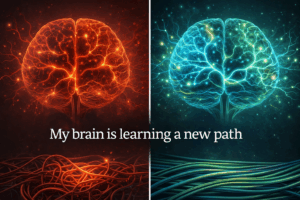
The new association does not have to be “true.” It will not feel authentic at first—and that’s okay. The purpose is not authenticity; the purpose is neural rewiring. Each repetition weakens threat-based neural patterns.
Using Mirror Neurons to Support Healing
Watch others engaging safely with what triggers you.
- If food is difficult, watch cooking or food shows where people delight in eating.
- If travel is a challenge, watch travel programs.
- If EMF is a trigger, observe someone using a phone with ease and joy.
Let your mirror neurons absorb what safety looks like in a regulated nervous system. Over time, this helps retrain your brain to interpret the world differently—which also supports DNRS implementation because your system begins to expect safety, not threat.
Final Thoughts
Changing beliefs isn’t about forcing positivity or denying reality. It’s about recognizing when the brain is stuck in survival mode—and gently guiding it back toward safety.
If DNRS feels hard to implement, it might not be a motivation problem. It might be a belief problem—an unconscious filter that keeps reinforcing danger, doubt, or impossibility.
When we bring those beliefs into the light and practice “two truths,” we create space for the nervous system to soften. And from that space, healing becomes more possible—one repetition at a time.